como criar um site


Computer hardwares shop

Showing posts with label SAPPHIRE. Show all posts

Saturday, February 4, 2012

Review: Sapphire Radeon HD 7950 OverClock Edition

Overview

Sapphire has waded in first with its take on AMD's latest HD 7000 series card, the Sapphire Radeon HD 7950 OverClock edition.

Unlike the AMD Radeon HD 7970 there are unlikely to be very many strictly reference models of the Radeon HD 7950. Instead we're more likely to see card manufacturers taking the opportunity to put their own spin on the PCB, clocks and cooling.

The HD 7970 was a reference model all the way down the line, with overclocked versions only coming much further down the release schedule. The Radeon HD 7950 though is being freed by AMD to allow manufacturers to do whatever they like right from day one.

With the impressive performance of the reference AMD Radeon HD 7950, which we've already seen, any improvement on that is going to be very welcome indeed.

And anything that offers even more overclocking potential with this already blazing fast GPU is just dandy in our books.

AMD's biggest card manufacturer, Sapphire, has opted to re-design the PCB and has created a new twin-fan cooling solution to sit atop the brand new slice of graphical silicon.

Sapphire has also opted to clock its Radeon HD 7950 OverClock edition 100MHz faster than the reference model we've already reviewed.

That's not quite as fast as the AMD Radeon HD 7970's 925MHz, but it's certainly not far short.

In fact, in certain areas, it's actually better.

Benchmarks

The benchmarks don't lie and show the Sapphire Radeon HD 7950 OverClock edition is only a fraction behind the vanilla Radeon HD 7970.

Thanks to the impressive overclocking potential within the Sapphire card, and the AMD Tahiti core in general, you can easily push the OverClock edition to the same performance levels as the HD 7970.

All of these benchmarks were run at 2560x1600, with the overclocking results taken at the relevant card's maximum achieved overclock.

There's little between them at the very top end of the OC tree.

DirectX 11 tessellation performance

DirectX 11 gaming performance

Sapphire radeon hd 7950 oc ed.

Sapphire radeon hd 7950 oc ed.

Overclocking performance

Sapphire radeon hd 7950 oc ed.

Sapphire radeon hd 7950 oc ed.

Sapphire radeon hd 7950 oc ed.

Verdict

As good as the reference version of the AMD Radeon HD 7950 is, the Sapphire HD 7950 OverClock edition is just better.

Coupled with the awesome overclocking potential of the Tahiti core is an excellent cooling array with whisper quiet dual fans.

Being able to keep the temperature well below that of the reference card gives us far more faith in the longevity of the chip given a serious overclock.

Sapphire radeon hd 7950 oc ed.

That's a good job considering the excellent Trixx overclocking utility Sapphire bundles with the card.

That software is intrinsic to the extra performance we were able to wring out of the HD 7950 OverClock edition.

The AMD overdrive software runs out of track at 1,100MHz, while Trixx will allow us to push the card up to 1,300MHz and play around with the voltages to help us get close to the limits.

We quickly managed to hit a 1,170MHz core clock speed with the Sapphire sample we've been playing with.

And that's faster than we were able to push the Radeon HD 7970.

So the performance is excellent, on par with the top-end AMD HD 7970, and the cooling array makes for near silent graphical power play.

There's got to be a catch, right?

Well, we're still looking, but we'll be damned if we can find one…

At £360 it's only a tenner more expensive than AMD is recommending the reference design be sold for, and around the same amount cheaper than the rivalling Nvidia top-end card.

We say rivalling, but really there is no contest. The Sapphire HD 7950 is cheaper and knocks the Nvidia GeForce GTX 580 about like a tiger playing with a toddler.

Nvidia then has some work to do to rival this excellent card.

The only problem we can see has no real bearing on the end user at all and is only really an issue for AMD.

Nobody is going to want the HD 7970 now there's a card which is practically as good for over £100 less.

We liked

The raw performance of the HD 7950 is a known quantity now, as is its overclocking potential. With the Sapphire backing though it's an even better GPU.

There's also the power-saving goodness of the AMD ZeroCore Power technology which turns off most of the GPU when it's not needed.

We disliked

We're struggling to think of something negative to say here. Aside from the fact you'll only get the true value of this card with a big-screen, 2560x1440 or 2560x1600 monitor, there's nothing to say.

Verdict

Quite simply this is the only card we'd consider spending cash on if we were looking for a serious GPU upgrade.

]]>
Continue reading →

Saturday, January 14, 2012

Sapphire Shows Off Vid 2X, Motherboards, etc.

Sapphire was showing off their latest products in their suite, including a just-in-from-Taiwan Ivy Bridge motherboard, along with X79 and 990FX motherboards for SNB-E and Bulldozer. Also on display were several graphics cards; the 7970 was a given, but the other two are a bit more esoteric. The 6450 Flex includes two DVI-D outputs and an HDMI output, plus an HDMI-to-DVI, allowing to drive three DVI monitors from a low profile card. The other card is a 6670 low profile card, which as far as we know is the only retail low-profile single-slot video card with that level of performance.

To go along with their graphics cards, Sapphire is also preparing to start shipping a new product, the Vid 2X. There are two models, one that takes dual-link DVI and can drive two single-link DVI displays at FullHD resolutions. The other Vid 2X has a DisplayPort input and can again drive two single-link DVI displays. We’ve seen other similar hardware before (e.g. Matrox has their DualHead-2-Go product line), but Sapphire’s Div 2X is hardware agnostic and looks at the EDIDs of the connected displays and then presents itself as an EDID display capable of twice that resolution (e.g. 3840x1080 maximum for two connected 1080p displays).

The device can work with any GPU, and if you want to do bezel correction there are six DIP switches that allow you to control bezel correction from as few as 4 pixels up to 186 pixels (in 4 or 6 pixel increments). You can also send a single signal over, and the first DIP switch controls clone or center modes (the latter mostly being for digital signage usage). Sapphire had the Div 2X connected to a MacBook Pro 13 driving two 1080p panels at 3840x1080, along with the laptop’s built-in display. Obviously rendering performance for that many pixels will require a lot more GPU power than the SNB HD 3000, but for other uses that just need lots of displays (e.g. day traders), such products are very popular. Availability should be widespread by the end of the month, with an MSRP of $179.

Another product on display was their Mini-PC Edge-HD3, a netbook packing AMD’s recently updated E-450 APU. The unit is very small and should offer much better performance than previous Atom-based netbooks (including Ion), with 4GB RAM, a 320GB HDD, and HDMI output (along with VGA and audio). Availability is expected in February for around $300.

Gallery: Sapphire Shows Off Vid 2X, Motherboards, etc.

]]>
Continue reading →

Friday, June 3, 2011

Review: Sapphire Radeon HD 6950 2GB

With the Sapphire Radeon HD 6950, we're getting into serious graphics card territory here, and inevitably that means serious money too. At over £200 that's a lot to spend on a single component if you're talking about an upgrade purchase.

But it's AMD's latest, and arguably greatest, GPU technology inside that Cayman processor and it's got some heavy-weight DirectX 11 graphical architecture backing it up.

Taking the seriously GPU taxing DirectX 11 tessellation-heavy benchmark of Metro 2033 there is no Nvidia card that can come close to managing double-figure frame rates at the highest 2,560 x 1,600 resolution until you get up to the £400-odd GTX 580. And even that card can only manage an extra 2fps over this impressive GPU.

It was an odd one from AMD's perspective as it launched both the HD 6950 and the other Cayman-powered card, the HD 6970, at the same time.

Despite the fact there was a gulf of around £80 in cost, there was very little between them in terms of raw performance. In the overclocking stakes the HD 6970 had the edge, but that was only down to the fact AMD had artificially limited the clockspeeds on the HD 6950 so as not to allow people to push the cheaper card as far as it's slightly more powerful brethren.

Stranger still was the fact that barely a week after release there was a BIOS flash for the HD 6950 that enabled you to open the dormant parts of the Cayman GPU to essentially turn it into a HD 6970 for free.

Hero card

That has made the original reference HD 6950 very much the hero card of the hour, and also much sought after.

Some recent respins though have come either with the dual BIOS switch disabled, or with lower frame buffers, both of which stop any flashing shenanigans you might wish to perform.

From a cynical point of view though, you could say it wasn't a coincidence that this happened at the same time AMD launched its multi-GPU HD 6990. Word from leading AMD manufacturers suggests we could still see new HD 6950s with the flashing reinstated.

As a graphics upgrade though, especially on the AMD side of the CPU war, the HD 6950 is definitely the one to aim for. It represents a huge step-up in power, even with the weakest of the CPUs, and when compared with the much more expensive GTX 570; that though, is on the AMD side.

When you factor in an Intel CPU based platform the AMD cards suddenly don't look quite so capable, and the more expensive Nvidia GPU wins the day.

Still, if you're rocking an AMD system then AMD graphics cards make the perfect match. Full platforms, innit?

Related Links
Continue reading →

Sunday, May 8, 2011

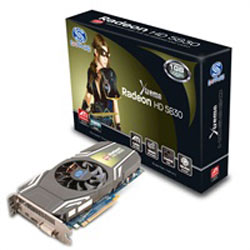
SAPPHIRE Brings Back AMD Radeon HD 5800 Series with New Xtreme Editions

Hailed as the most exciting development in graphics for several generations, the original SAPPHIRE HD 5800 series not only included the fastest single GPU available, but was also the first family of video cards in the world to support the advanced graphical features of Microsoft DirectX 11 and multi-monitor displays in Eyefinity mode. Now it’s back – with the exciting new SAPPHIRE HD 5800 series Xtreme Editions! Two models will be available from April 2011 – the SAPPHIRE HD 5850 Xtreme and the SAPPHIRE HD 5830 Xtreme. Both will represent spectacular value for money – and support all the latest games and applications.

SAPPHIRE HD 5850 Xtreme

With a 150GB/s memory interface to 1GB of the latest GDDR5 memory, and a GPU architecture with a total of 1440 stream processors and 72 texture units, the new SAPPHIRE HD 5850 Xtreme speeds through older DirectX10.1, DirectX 10 and DirectX 9.0 games and applications – as well as delivering stunning levels of performance, detail, transparency and lighting effects in the latest DX11 games and applications. Not far behind is the SAPPHIRE HD 5830 Xtreme Edition with its 1120 stream processors and 56 texture units. With its core clocks of 800MHz and 1GB of DDR5 memory with speeds of 1000MHz (4GHz effective), it represents a breakthrough in value for money for the gamer. Both cards feature new SAPPHIRE original cooler designs, and optimised voltage regulation, which together with clock and memory speeds can be adjusted with the SAPPHIRE TriXX overclocking tool (free for users to download) to enhance performance. Both cards offer support for all the advanced graphical features of Microsoft DirectX 11 and deliver spectacular video clarity, speed and visual effects.

Continue reading →

Related Posts Plugin for WordPress, Blogger...

Top Gadgets

FUTURE COMPUTER